
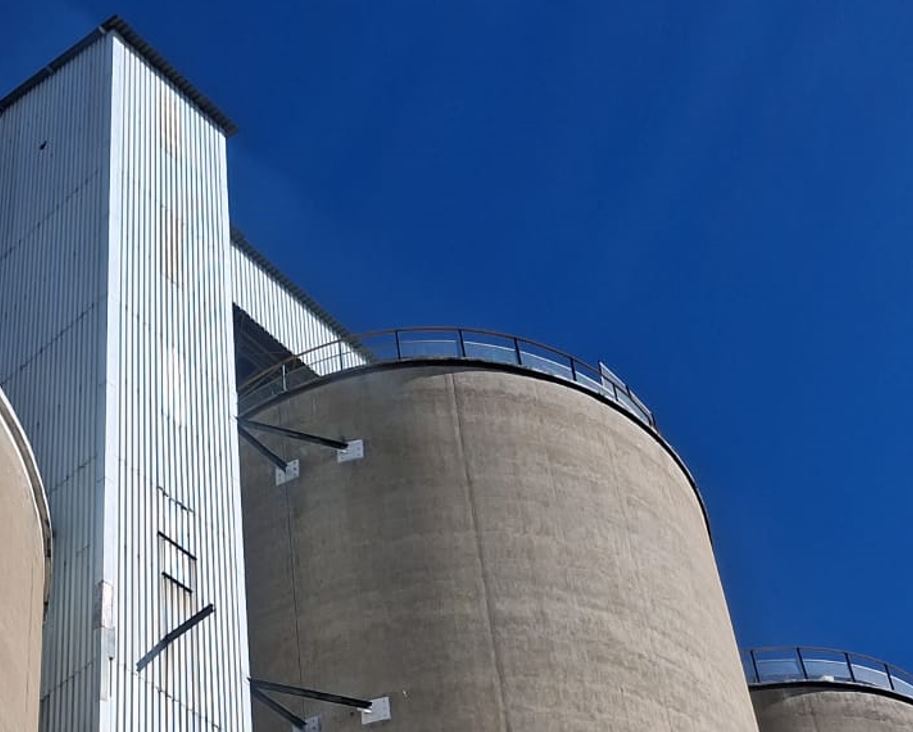
Citi-Con successfully completed complex concrete silo bin structural repairs for a steward of raw materials for food production. These interventions represent the most critical component of the concrete repair and corrosion protection solutions undertaken across various silo complexes.
Given the high-risk nature of the work, the project was supervised by Dion Rudolph, Citi-Con’s experienced Project Manager. He also provided valuable input into the engineer’s repair design to improve constructability.
“Importantly, we bring the practical, on-site expertise needed to deliver a successful outcome. Challenges included working safely in an area where temperatures often exceed 30°C and winds can intensify with little warning. By incorporating improved design features upfront, we were able to plan effectively around these conditions,” Rudolph says.
A case in point was his suggestion to increase the hole plate tolerances to a 50 mm outer diameter clearance. This significantly accelerated the work without compromising safety.
Concrete silo structural repair innovations
Rudolph was also behind many concrete silo structural repair innovations.
Leveraging extensive rigging experience, he devised a unique method to hoist the 45 kg plates to the various working faces. This addressed the fact that they were too heavy for rope-access technicians to carry. Cutting the plates was not an option, as this would have compromised their structural integrity.
Concrete silo structural repair scope
The concrete silo structural repair scope involved reinforcing the primary support beams. These included 10 on the rigid side of bin 20 and two on the flexible side of bin 21. They tie into the steel interconnect structure linking the two units. Over time, differential movement between the structures had caused shear-related distress and concrete breakout at the beam–wall connections. If left unaddressed, this deterioration posed a significant risk of structural collapse.
Work began on bin 20, replacing the five front and five rear beams in sequence. Rudolph and his team started at the lowest level, completing one beam per day.
“There was zero margin for error; even the slightest mistake could have triggered a collapse,” he says. “When reinforcing the final beams, we were working at heights of approximately 37 m and within extremely tight tolerances. These ranged from two to three millimetres when positioning the plates.”
Engineered concrete silo structural repairs
The engineered concrete silo structural repairs required cutting back each existing beam by 50 mm. Thereafter, a new H-plate reinforcement system was installed.
Rudolph’s team began by cutting back each existing beam and removing it. The beam was then used as a template for precise measurement and drilling.
Six 200 mm-deep holes were then drilled through the concrete using one of Citi-Con’s powerful core drills. Thereafter, threaded bars were inserted and secured with chemical anchoring mortar. It achieved full strength in just 30 minutes.
A 600 × 600 × 12 mm internal plate was then hoisted and aligned with a 100 × 100 × 6 mm washer plate. The nut was secured to the internal anchor point.
The new A4 stainless-steel plates using high-tensile bolts, spring washers, and lock nuts were then attached.
Quality concrete silo structural repair
“Once again, quality concrete silo structural repair was maintained throughout,” he says. “All plates were CO₂ welded at 45° and 90° angles. Offering deep penetration and high deposition rates, CO₂ welding is particularly suited to thick steel. A sealant was also applied between the beams for waterproofing. This was followed by anti-corrosion and final protective coatings.”
By the time the project was completed, Citi-Con had safely handled and installed more than 700 kg of structural steel.
“This project reinforces our position as the trusted partner for advanced silo repair and strengthening. By combining practical engineering insight with precision execution, we continue to extend the lifespan of these vital structures,” Rudolph concludes.