
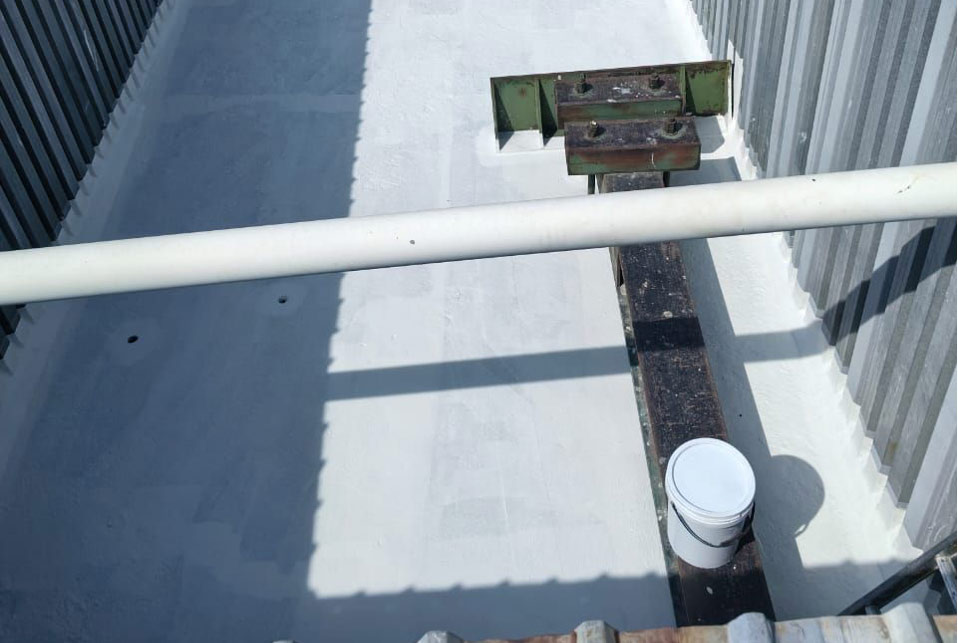
Harnessing our rope-access capabilities, Citi-Con offers a significantly faster, more cost-effective and practical silo bin roof repairs.
From mobilisation to project completion, rope access is significantly faster than alternative methods. This speeds up the overall timeline of building maintenance and repair projects. By eliminating the need for traditional scaffolding, rope access reduces project overheads significantly. Rope access is also one of the safest work-at-height methods when performed by qualified rope access technicians. All our rope access operations are undertaken according to standards established by the Institute for Work at Heights [https://ifwh.co.za/].
A case in point is the extensive silo bin roof repairs that we recently completed for a leading food producer. This, while working to a very tight deadline and budget. Thus, there was very little scope for error throughout the three-week contractual period.
Silo bin roofs play a crucial role in maintaining the overall functionality and longevity of these structures. This is by protecting the contents stored inside from contamination and the elements. They also provide structural support, regulate temperature and enhance safety.
Regular inspections and maintenance will help to extend the lifecycle of silo roofs. A professional should be appointed to check for damage and undertake repairs timeously. Repairs need to be undertaken by approved applicators of repair systems and strictly according to manufacturers’ requirements. Citi-Con collaborates with manufacturers and suppliers of high-quality maintenance and repair systems. As such, we can warranty our work for the maximum available term.
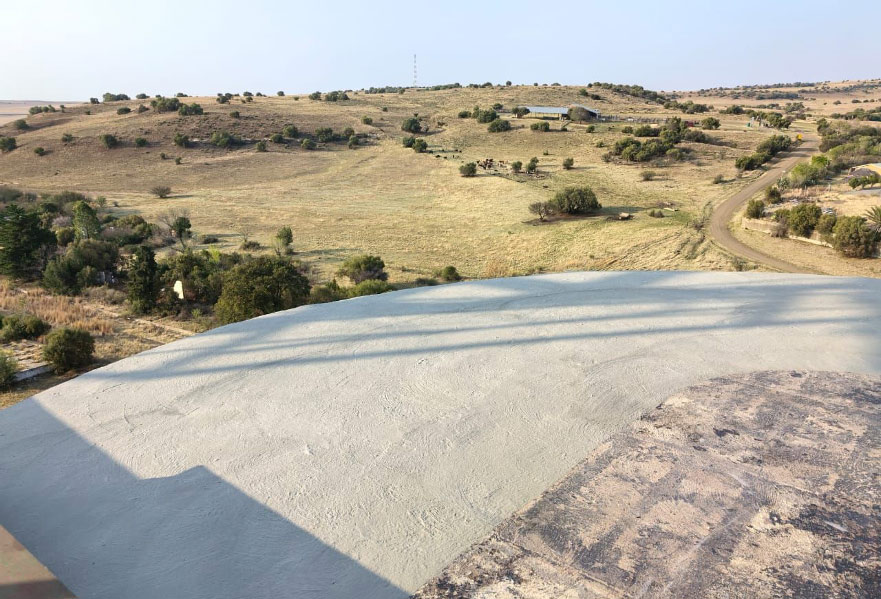
Citi-Con’s silo bin roof repairs involved extensive preparation. This included removing layers of torch-on waterproofing membranes placed and placed on top of one another acrylic membranes. Because they were incompatible, there were major adhesion issues and problems. These included blistering and eventual failure.
It is imperative that silo bin roof coatings fully adhere to the substrate, as opposed to acting as floating membranes. The smallest hole in non-bonded, floating membranes allows water transmission or ingress throughout the entire silo bin’s surface. Water is trapped between roof membranes and the top of the silo bin roof slabs, or it leaks down silo walls. In freezing temperatures, trapped water expands and contracts, causing structural cracking within the cracking within the silo roof bin slab. This unseen damage can also lead to unexpected safety issues despite regular inspections.
Using mechanical grinders, we stripped the damaged waterproofing membranes until we reached the screed.
Silo bin roof screed repairs
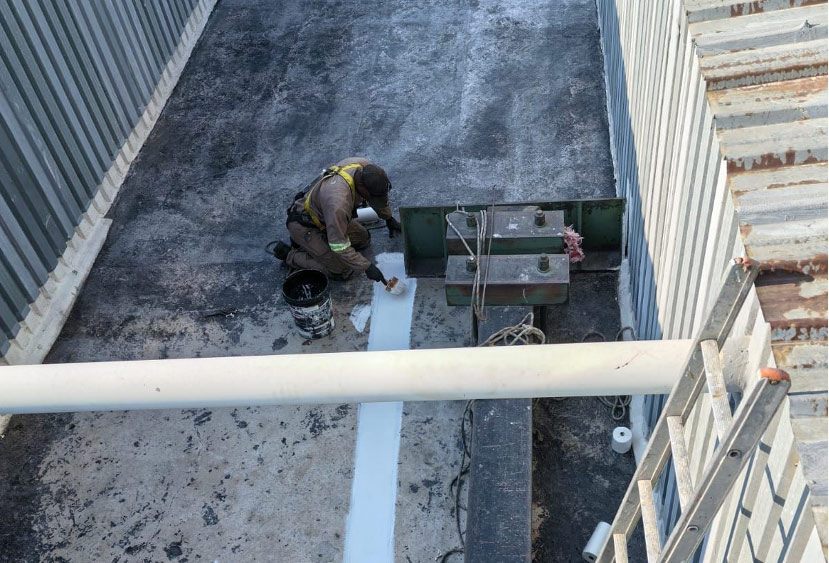
The silo roof screed underwent repairs and primed with StonCor Africa’s Prostruct 610/601 [pds-pro-struct-610-601-april-2025.pdf]. This modified polymer waterproofing mortar promotes adhesion between screeds. It also enhances water, chemical, oil and abrasion resistance of cement mixes.
Thereafter, a new primer screed was block brushed and levelled using a cement mix that was optimised with 610/601 primer. It was then sealed with three coats of Stoncor 680FR, a high-performance liquid resin. pds-pro-struct-680fr-march-2014.pdf is a flexible crack bridging membrane compatible. It is tough, durable and impact resistant and provides excellent adhesion to concrete and roofing materials.