
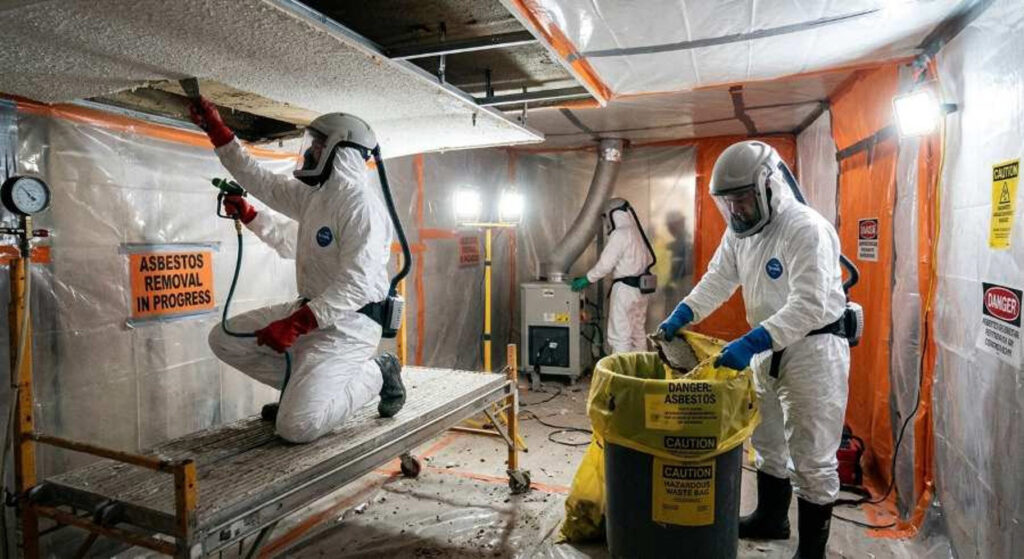
South Africa’s Asbestos Abatement Regulations require a proactive approach to identifying asbestos-containing materials, controlling exposure and planning maintenance. Citi-Con helps asset owners meet these requirements while reducing risks to workers, occupants and contractors.
Asbestos can remain hidden in buildings and industrial facilities for decades. This creates risks that may only become apparent when materials deteriorate or maintenance and refurbishment work begins. For asset owners, the challenge is to understand where asbestos-containing materials (ACMs) are present. They must also assess their condition and manage the risks they pose throughout an asset’s life.
Asbestos Abatement Regulations, 2020 GG43893.pdf were published under the Occupational Health and Safety Act 85 of 1993. They establish requirements for identifying, assessing and managing asbestos at workplaces. These obligations have practical implications for property owners, facilities managers, industrial operators and organisations responsible for ageing infrastructure.
Compliance requires more than a once-off inspection. It calls for an ongoing, documented approach to asbestos management, supported by appropriate technical expertise.
Asbestos abatement specialists identify asbestos
Asbestos abatement specialists can help asset owners identify asbestos-containing materials and establish an accurate inventory to meet regulatory requirements.
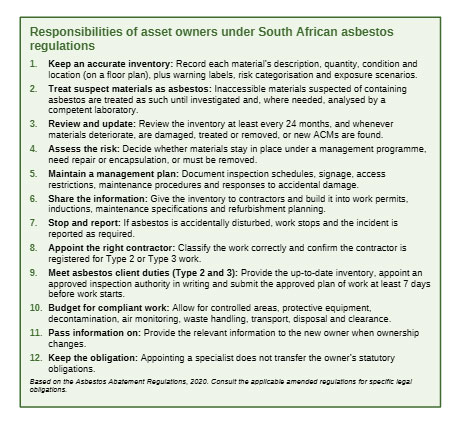
This inventory must record relevant information. It includes the material’s description, quantity, condition and location, with locations detailed on a floor plan. Relevant warning labels, risk categorisation and potential exposure scenarios must also be addressed.
Inaccessible materials suspected of containing asbestos must be treated as such until investigated. Suspected materials can be sampled and analysed by a competent laboratory.
The inventory must be reviewed at intervals not exceeding 24 months. It must also be updated when circumstances warrant it. This includes noting when materials deteriorate, are damaged, treated or removed, or when additional ACMs are identified.
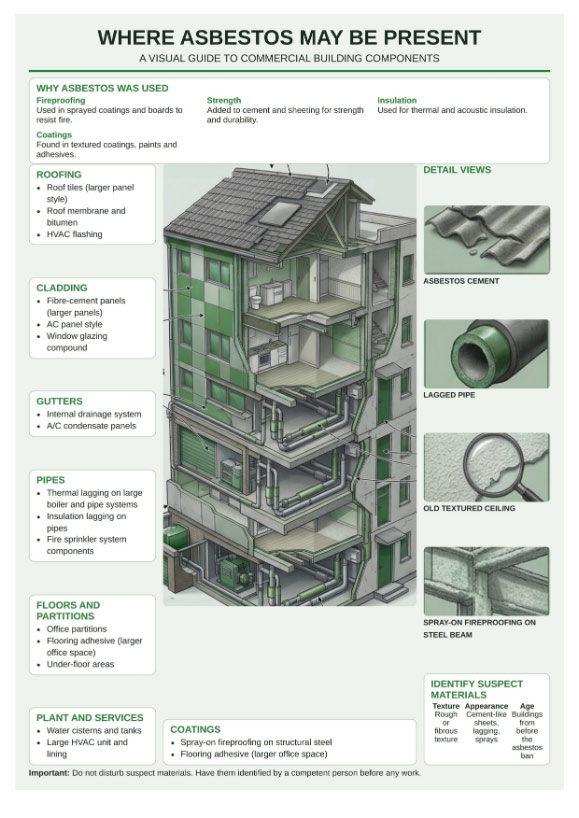
For asset owners, this creates an ongoing responsibility to maintain accurate information about their properties. Asbestos may be present in roofing, cladding, gutters, pipes, insulation boards, coatings and other building components. Without reliable records, maintenance teams and contractors may unknowingly disturb hazardous materials.
The inventory is therefore an important source of information for maintenance planning, contractor management, refurbishment, demolition and property transactions. Relevant information must also be provided to a new owner when ownership changes.
Asbestos abatements specialists understand risks
Asbestos abatement specialists help owners and employers understand risks associated with the materials and determine how these should be managed.
Risk assessments consider factors such as the material’s condition, the likelihood of disturbance and the potential for exposure. The findings inform decisions about whether materials can remain in place under a management programme. They may require repair or encapsulation or should be removed.
Not every asbestos-containing material requires immediate removal. Intact materials that are unlikely to be disturbed may be managed in place. This is if the appropriate and compliant with the applicable requirements. However, deteriorating materials, damaged insulation and asbestos in areas subject to frequent maintenance may demand more urgent intervention.
A management plan is key to risks associated to handling asbestos – Department of Employment and Labour. A documented asbestos management plan translates the assessment into practical measures. These may include inspection schedules, warning signage, access restrictions, maintenance procedures and arrangements for responding to accidental damage.
For owners managing multiple buildings or facilities, this approach also supports more effective budgeting. It helps prioritise urgent risks while incorporating planned interventions into maintenance programmes and capital expenditure.
Asbestos abatement specialists prevent exposure
Asbestos abatement specialists prevent accidental exposure.
One of the most significant risks arises when asbestos is disturbed during routine work. Drilling, cutting, replacing services, repairing roofs and undertaking refurbishment can release hazardous fibres. This is if asbestos-containing materials are not identified and controlled.
The regulations have implications for both asbestos specialists and contractors performing other work at a site. Relevant inventory information must be made available, and workers must avoid disturbing asbestos. If accidental damage or disturbance occurs, work must stop. The incident must then be reported in accordance with the applicable requirements.
Asset owners should therefore integrate asbestos information into work permits, contractor inductions, maintenance specifications and refurbishment planning. Contractors need to understand the hazards before work begins.
This is particularly important in operational environments where maintenance cannot simply be postponed indefinitely. Early identification allows owners to plan safe access, select suitable contractors and minimise disruption to building occupants and business operations.
Categories of asbestos abatement work
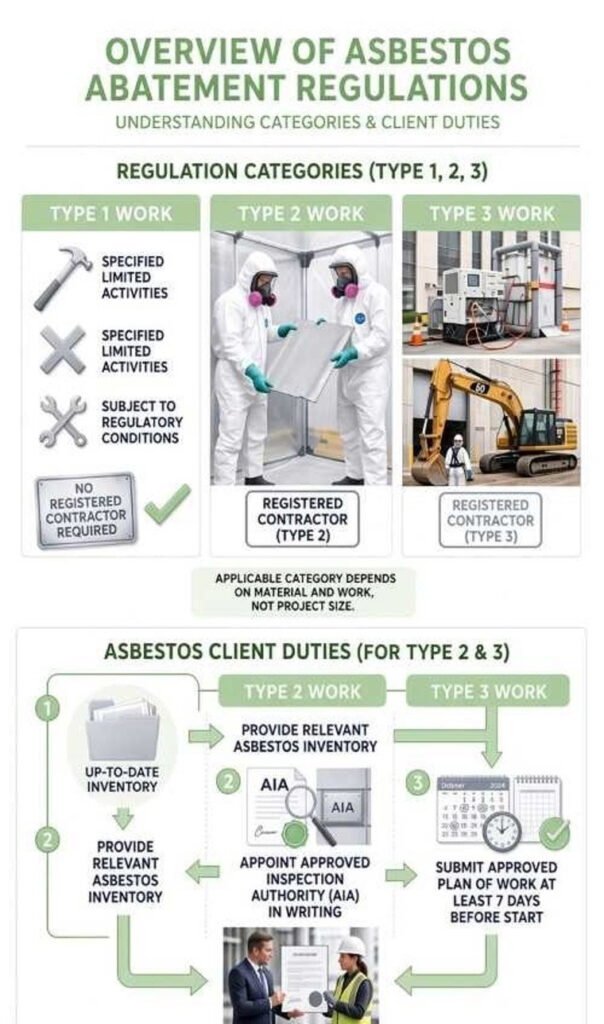
The regulations distinguish between different categories of asbestos abatement work. The applicable category depends on the material involved and the work being undertaken, not simply the project’s size.
Type 1 work covers specified limited activities, subject to regulatory conditions. Type 2 and Type 3 work require contractors registered for the relevant category. The requirements for Type 2 and Type 3 projects include formal planning and inspection arrangements.
For applicable Type 2 and Type 3 work, the asbestos client has specific duties. This includes providing the relevant up-to-date inventory and appointing an approved inspection authority in writing. The approved plan of work must be submitted at least seven days before work starts.
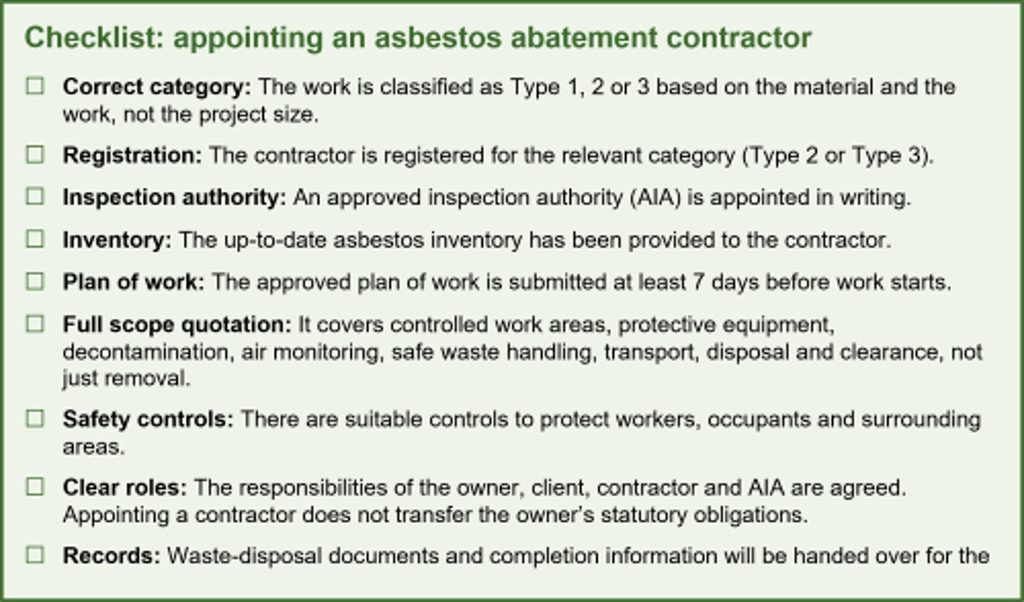
Asset owners should verify that the contractor has the appropriate registration. It must also have the required inspection, planning and safety arrangements are in place before work begins. Incorrectly classifying a project or appointing an unsuitable contractor can create compliance risks, delays and additional costs.
The project budget must also account for the complete scope of compliant work. Depending on the project, this may include establishing controlled work areas, protective equipment, decontamination, air monitoring, safe waste handling, transport, disposal and clearance procedures.
A quotation that focuses only on physical removal may not reflect the full cost of managing asbestos safely.
Asbestos abatement supports compliance
As a specialist asbestos abatement company, Citi-Con supports asset owners turn regulatory requirements into an effective management programme.
Our involvement can begin with competent inspections and the identification of suspected ACMs. This includes coordinating laboratory analysis where necessary. The resulting information supports the development or updating of the asbestos inventory.
We can also help owners understand the condition of materials, identify potential exposure pathways and prioritise interventions. This allows decisions to be based on risk rather than assumptions or a blanket approach to removal.
Where work is required, we can plan and undertake appropriate removal, repair or encapsulation. Our work follows the applicable regulatory requirements and the approved methodology, with suitable controls to protect workers, occupants and surrounding areas.
We also coordinate with the approved inspection authority on required inspections, air monitoring and clearance procedures. Project records, waste-disposal documentation and completion information can then support the owner’s ongoing asbestos management records.
However, responsibilities must be clearly allocated. The asset owner, asbestos client, registered contractor and approved inspection authority have distinct roles. Appointing a specialist does not automatically transfer the owner’s statutory obligations to that contractor.
Proactive asbestos abatement services
Proactive asbestos abatement services are ultimately an asset-management issue as well as an occupational health and safety responsibility. Poorly managed asbestos can expose people to harm, disrupt operations, complicate refurbishment and create avoidable project costs.
Asset owners should begin by checking whether their inventories and risk assessments are current. They must identify materials requiring attention and ensure that asbestos information reaches everyone planning or undertaking work. They should then prioritise interventions, allocate appropriate budgets and verify that contractors meet the applicable requirements.
The regulations do not mean that every asbestos-containing material must automatically be removed. They require a considered approach to identifying materials, assessing risks and implementing appropriate controls.
Citi-Con provides the technical knowledge and practical capability to support this process. By involving them early, asset owners can make informed decisions, plan compliant interventions and manage asbestos risks. This is before they become a threat to people, operations or the long-term value of their assets.
Note: This article interprets the Asbestos Abatement Regulations, 2020, in practical terms. The applicable amended regulations should be consulted when determining specific legal obligations.